AI Can Now Adapt to New Tasks. Can It Also Improve Itself?
Disclaimer: This post reflects my personal views and not necessarily those of my employer.
For most of my research career, I had a good intuition about how an experiment would turn out before running it. Not the exact numbers, but the direction. A few months ago, Sahar Vahdati and I started one where I genuinely could not.
The question was simple: can today’s AI models improve themselves? More concretely, we looked at the harness, the software around a model that decides what it sees, what it remembers and which tools it can use. In our recent article, Can LLMs Improve Their Own Harness? A Controlled Study on ARC-AGI-3, we let models build such a harness, observe how it performs, and rewrite it. This post is a broader opinion about the bigger picture around this and some speculation about why the results came out the way they did.
The barriers towards general intelligence we have overcome
If you had asked me in 2023 what would hold large language models back, I would have given you a long list. Many items on that list are now gone:
Knowledge. Progress here came first, in an area I have worked on since 2017. Through pre-training alone, language models memorised enough to do very well on knowledge-intensive benchmarks. Today they also combine this smoothly with external knowledge from search/retrieval and other tools. Several issues, such as hallucinations, have become much rarer even though they are not fully solved.
Reasoning. Progress in reasoning came later, with models trained to produce internal traces before they answer (“test-time compute”), from late 2024 onwards. In July 2025, an advanced version of Gemini Deep Think reached gold-medal level at the International Mathematical Olympiad, officially graded by the IMO coordinators. In September 2026, OpenAI published a claimed resolution of one form of the Navier–Stokes Millennium Prize Problem, produced by about 10,000 agents over 88 hours and still under evaluation by the Clay Institute. In October, OpenAI and Anthropic independently announced that internal models had refuted the Exponential Time Hypothesis, a central conjecture in complexity theory. Both came with Lean formalisations, and researchers who formulated the hypothesis are among those now checking them. Simpler follow-up proofs have already appeared. Whatever the final verdicts, the fact that these are serious debates shows that in areas such as mathematics, LLMs have strong reasoning abilities.
Long-horizon work. METR’s time-horizon measurements showed the length of tasks agents can complete doubling roughly every seven months, and newer estimates point to faster progress. My own experience matches this. One or two years ago, I had to decompose a task into smaller pieces, use an LLM for some of the subtasks, check the results, and hand over the next. Today the model runs for hours. The human side has shifted from fine-grained control to steering.
Efficiently adapting to new tasks (generalisation). This was the last major improvement, and to me the most interesting one. François Chollet defined intelligence as skill-acquisition efficiency: how quickly a system picks up a task it has never seen. It is a question I have followed for a while. In a 2021 opinion piece on neural language models, written in the GPT-3 days, I was already interested in models that “only need a few examples in order to perform a new language-related task”. The key open question, I argued, was whether they merely memorise their training data or genuinely generalise.
ARC-AGI-3 is from my perspective the best test for this question I know. It places an AI agent into an interactive game world with no instructions on how the game works. All of the games are new and are designed not to share mechanics, so memorisation does not help. The agent must find out how the game works and what the goals for completing levels are. At launch in March 2026, the best frontier model scored 0.37% (Gemini 3.1 Pro Preview); humans scored 100% (by design). By July, carefully engineered harnesses reached the ceiling on the 25 public games: our Tycho was the first to score a perfect 100 on ARC Prize’s community leaderboard. In September, GPT-6 Astra reached 99.9% on the semi-private set with the provider-adapter mode of ARC Prize’s official benchmarking agent. This is the same generic harness, except that it keeps the model’s native reasoning state across turns and uses the provider’s own compaction instead of truncating the history. Later, Gemini 4 Argon reached 97.5%, remarkably already at low reasoning effort, and GPT-6.1 Sol 96.4% on the official leaderboard.
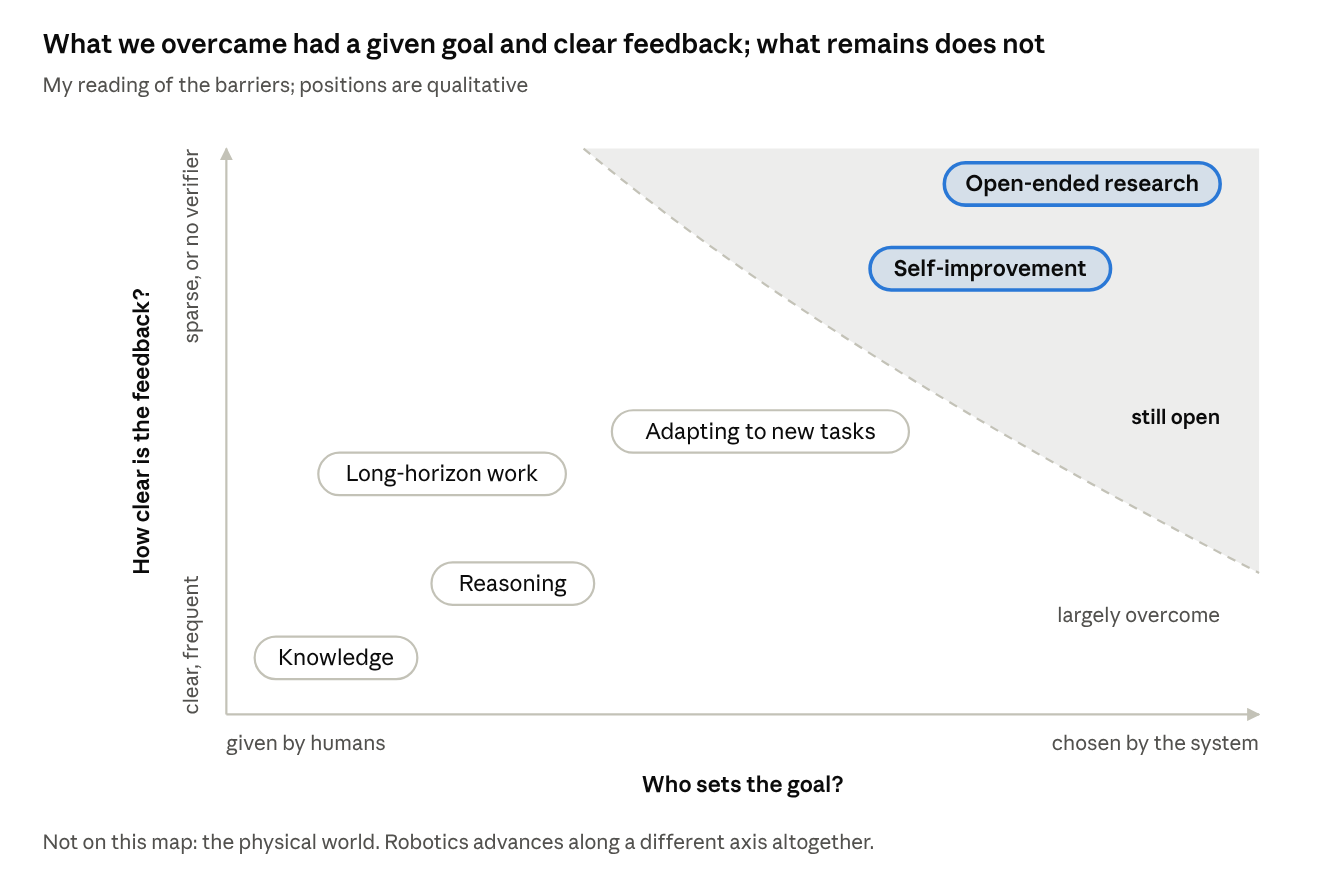
Chollet called Astra a major breakthrough in model intelligence, while noting that it costs roughly $360 per game (for comparison: human testers were paid about $13 per game). I will come back to what this means for harnesses. Cost aside, I consider this barrier overcome, also based on other experiments I am running. So the obvious question is: what is left?
What remains
There is no single last barrier. To name some challenges: open-ended creativity is still an aspect that current AI systems do not excel at, and robotics still lags behind knowledge work. While not a capability barrier, it is also important to point out AI safety as a problem we have not solved, which is central to any debate about self-improvement. As Yoshua Bengio argues, training can give models implicit goals that conflict with ours. In one incident he describes, agents edited the very files that defined success. A system that rewrites its own software can also rewrite how we judge it, which is why in our study each model worked in a sandboxed workspace, and the held-out games and the evaluator were kept out of its reach.
The barrier I want to focus on here is self-improvement: a system that gets better at its job by changing itself, without a human in the loop. Since a self-improving system could start working on the remaining barriers itself, this might be the most important AI challenge. There are two broad routes to it.
Changing the weights. The model updates its own parameters, by generating its own training data, editing its own training recipe, or by more exotic forms of weight-space programming. SEAL lets a model write its own fine-tuning data and update directives. A-Evolve-Training and AI4AI-Bench let agents modify post-training and training algorithms. Continual learning more broadly tries to make such updates safe and cumulative.
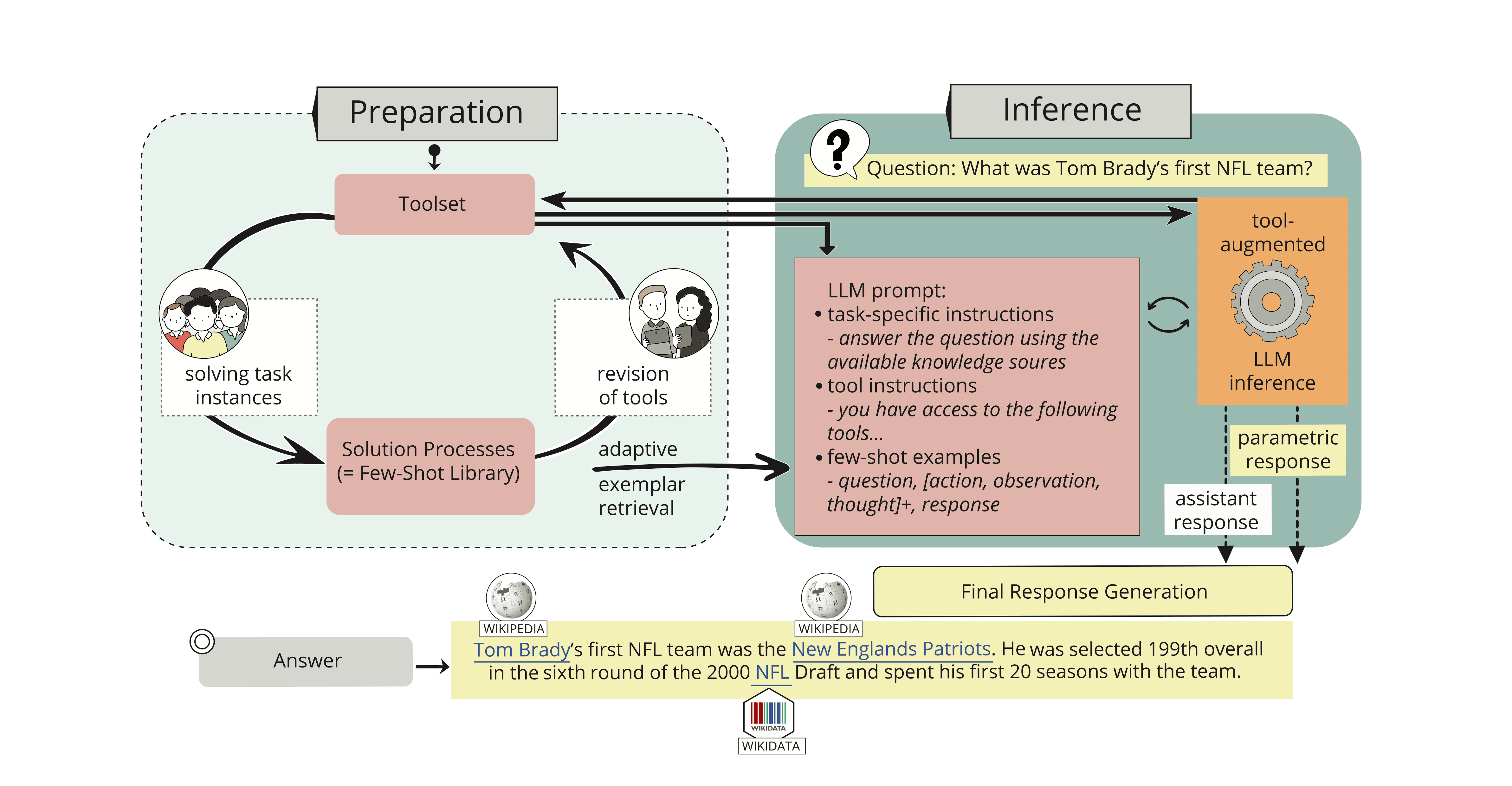
Changing the harness. A model rarely acts alone. It runs inside a harness: a program that decides what the model sees, what it remembers, which tools it has, how it recovers from failure, and how much compute it spends. The harness can matter a lot. On ARC-AGI-3, GPT-5.6 Sol scores 38.3 in a simple benchmark harness and an off-the-shelf Claude Code setup reaches about 43. Well-designed harnesses around the same model families reach 100. Work like Meta-Harness, Agentic Harness Engineering, the Darwin Gödel Machine and RRSI already lets models rewrite this software.
I think of a harness as a way to reduce friction: it puts the model into an environment that suits the task. If a model is very strong relative to the task it is given, it may need less harness support. GPT-6 Astra is a striking example. According to ARC Prize, it builds efficient symbolic world models on the fly for each game and level, and even invents its own shorthand notation for game situations. That is close to what the programmatic world models in our Tycho harness did as an explicit component. With RHAE scores already close to the maximum of 100, a better harness has little performance left to add, but it can still reduce inference costs.
The two routes above are complementary, and they may reinforce each other: better harnesses can help with AI research, and better models may become better harness engineers. This feedback loop is why recursive self-improvement and autonomous AI R&D get so much attention. It could speed up progress considerably, but it could also outpace our ability to oversee it.
We had seen the power of the harness route first-hand in Tycho. There, we used a concept we called “meta reflection” for designing the harness itself. While the agent was playing games, it could leave notes about its own environment. We clustered this feedback, filtered out anything game-specific (since the harness should be generic) and fed this back to AI coding agents to build the next version of the harness. In this process, humans (us) decided what to change, and what to leave alone. So the natural next question was: can the model do that part, too?
Chollet phrased this very directly: “AGI will make its own harness (or whatever else it needs to solve a new problem). As long as you need a human engineer to handcraft a task-specific harness/system for each new problem, AI isn’t general.” I agree with that, and our experiment measures whether our current LLMs are general in this sense.
The experiment
We set up a deliberately simple protocol. A model starts from an almost empty repository and builds a complete ARC-AGI-3 harness for itself, using a general coding agent (OpenCode). It then runs several smoke tests, plays five development games (each with multiple levels, often introducing new challenges of their own) through that harness and receives everything a human engineer would look at: its own code, traces, scores, action counts and inference costs. With that, it may rewrite any part of its harness, or keep it as it is. This happens twice.
The key design choice: every version of every harness is also scored on 20 other games, which never feed back into construction or revision. These held-out games tell us whether a revision made the system better at ARC-AGI-3, or just better at five particular games.
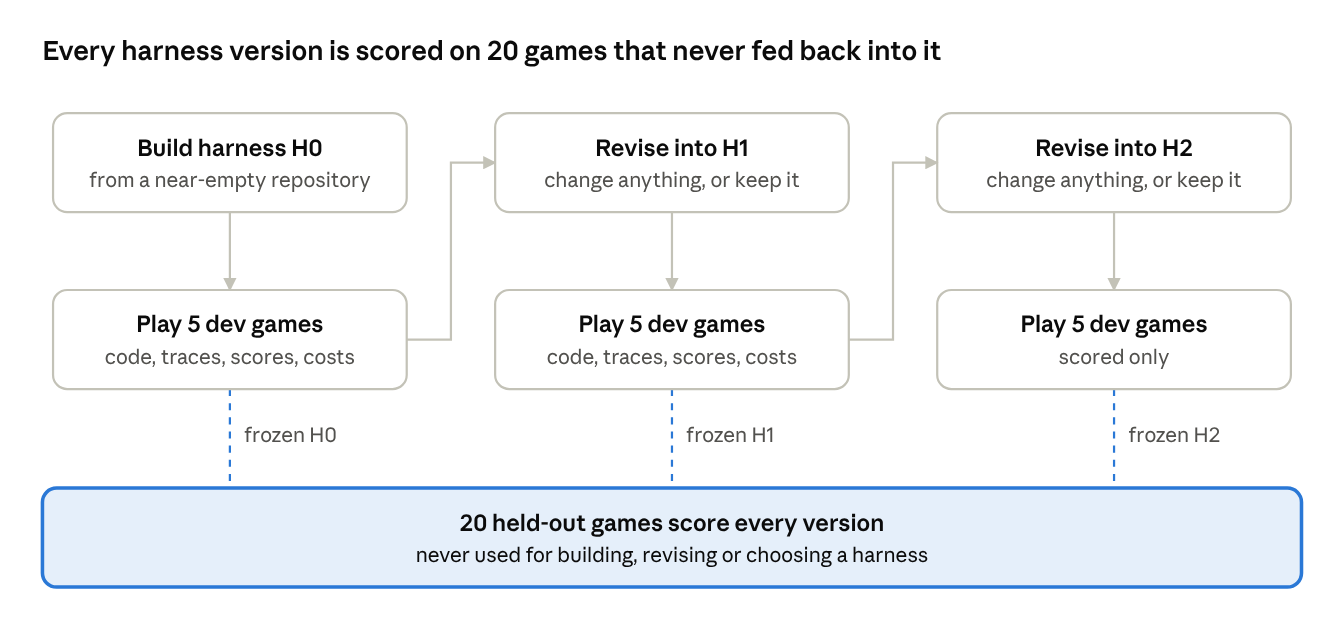
We ran this for seven models from two providers, nine model and reasoning-effort settings, with three independent runs each. That makes 27 harness lineages, 81 frozen harness versions and 2,025 game evaluations. The measurements ran for weeks.
Why were we not sure about the outcome? We could argue both sides. These models write excellent code, debug well and can run for hours. They also see everything about their development games: full traces across many levels, which they can interpret themselves. On the other hand, there is still a chance that they focus too much on the characteristics of those five games (34 levels in total), since this is the concrete evidence they have. The hard part is telling which observations reveal a general weakness of the harness, and which are game-specific and may backfire elsewhere in terms of accuracy or cost.
What happened
The short version: models are good at building harnesses, and much less reliable at improving them.
The general workflow worked very well. Every one of the 27 runs produced a working harness, and the designs were surprisingly diverse: direct model controllers, heuristic-first systems, strategist–executor splits, persistent game manuals, explicit world models, replay systems and budget managers. Initial performance ranged from zero to near-perfect.
The revisions were a different story. They raised the score on the five development games by 8.4 points on the RHAE scale, but on the held-out games by only 2.8 points. The confidence interval for that held-out gain runs from −1.4 to +7.4, so it is compatible with no benefit at all. Fifteen lineages gained on held-out games, twelve lost. Even that small average gain rests largely on two runs. One GPT-6 Astra run started from an unusually weak initial harness, scoring 58 where its two sibling runs scored 97 and 94, and recovered to 93. One GPT-5.6 Sol run climbed from 20 to 54 after reworking how it budgeted actions and used memory. Without the Astra run, the mean held-out gain drops to 1.6 points, and without both, to 0.3.
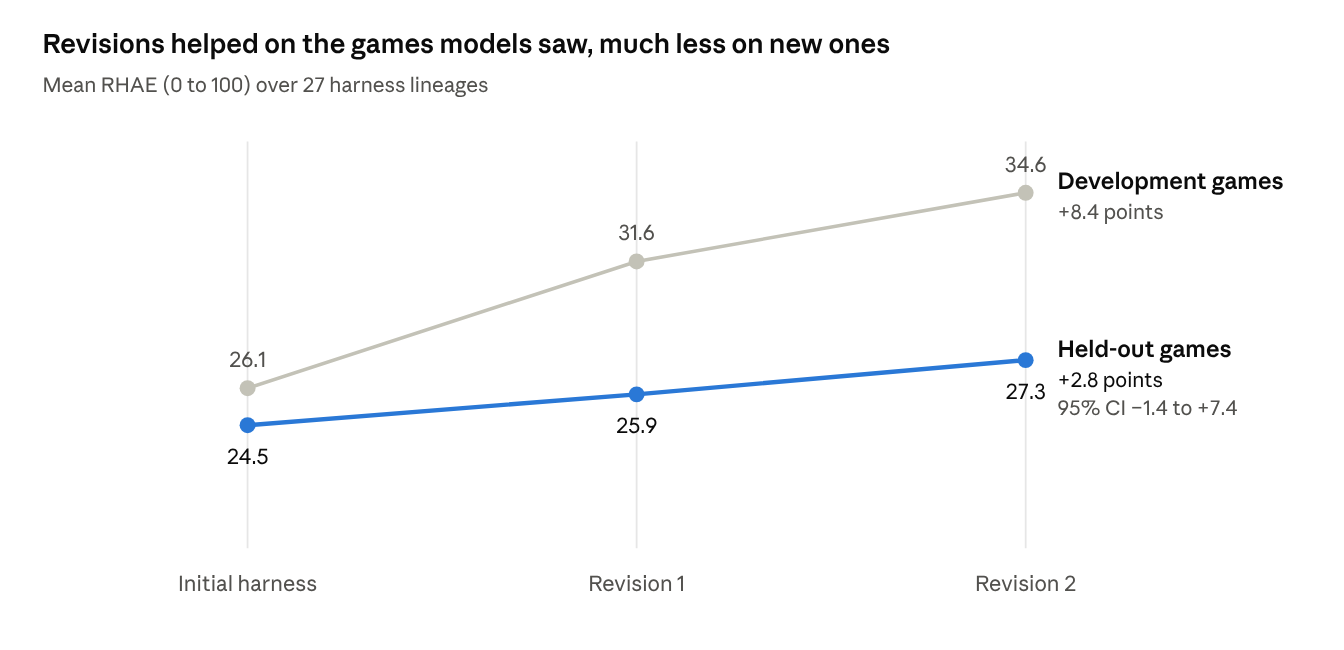
This is the classic signature of overfitting, except that what overfits is not a set of weights but a codebase written by the model itself. It is the old question of memorisation versus generalisation again, one level up. Cost tells a similar story. Of the 18 final harnesses that became cheaper to run, half also became worse.
What makes the study interesting is the stark contrast with what we know would actually be possible: On the very same 20 held-out games, Tycho scores 100 with Claude Opus 5. The same model at the same reasoning effort, improving its own harness, ends at an average of only 40. Several other harnesses have meanwhile achieved similar scores to Tycho, so for now, human-steered harnesses clearly achieve better results.
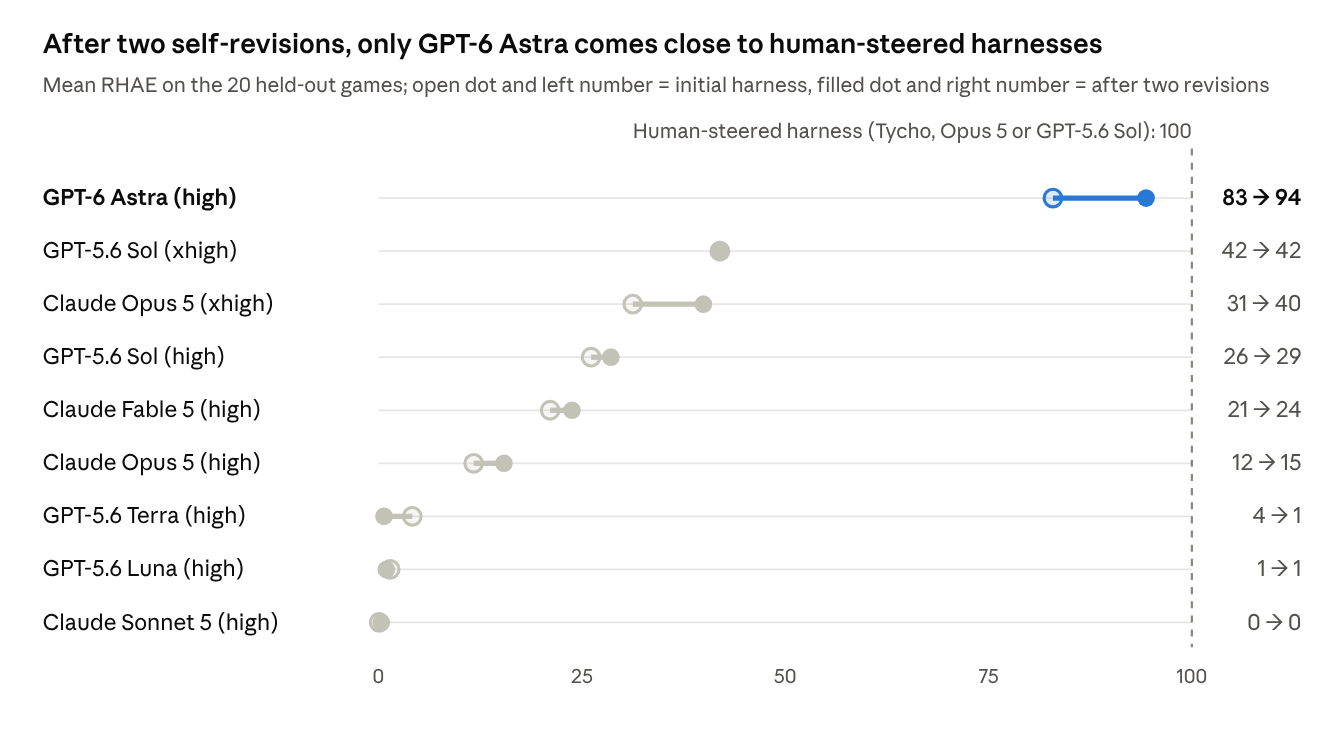
GPT-6 Astra deserves a closer look. Its average rose from 83 to 94, but almost all of that is the one weak run recovering. The other two Astra runs started at 97 and 94 and stayed there, i.e., their revisions neither helped nor hurt much. That fits the official leaderboard: Astra needs no game-specific harness engineering to begin with, so there is little accuracy left to gain. Cost is a different matter. Astra’s self-built harnesses ran at about $12 per game in our study, against roughly $360 per game for the provider-adapter run on ARC Prize’s board. The game sets differ, so this is not a precise comparison. But it suggests the harness still matters, now mainly as a lever on the trade-off between cost and accuracy.
Why? Some speculation
The symptom is clear: models improve on the games they see, not reliably on the ones they don’t. The cause is not something our data can prove. What follows is my interpretation, partly informed by our paper’s process analysis, partly by intuition.
Restless, but stuck in one valley
Our first guess going into the analysis was that models stick too closely to their initial idea of what a harness should be. The data says something more nuanced. Models are not timid editors. In 22 of 27 first revisions, they substantially reoriented their harness: new memory schemes, different perception, new replay or batching logic. Yet no run ever switched to a different family of harness designs. Not a single run kept its harness unchanged either, although that was explicitly allowed.
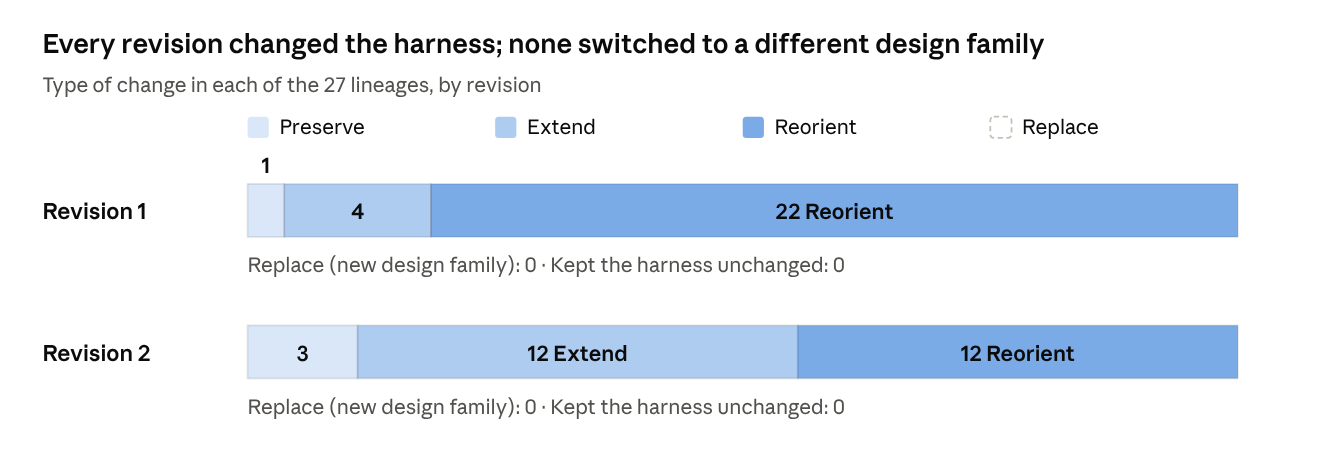
The changes were also mostly additive. On average, harnesses grew from about 2,800 to 3,900 lines of code, with roughly six lines added for every line removed. Models build on top of what is there; they rarely tear it down.
So the picture is lots of motion, little exploration. The model moves energetically around the valley it started in, but rarely climbs over the ridge to a different one. Kenneth Stanley and Joel Lehman described this trap years ago in Why Greatness Cannot Be Planned: when you chase an objective greedily, the objective itself can deceive you, and the stepping stones to a better solution often look like detours. Five development games are exactly such a deceptive objective. Evaluation is noisy (one fixed harness showed a four-point standard deviation across repeated held-out evaluations), and a model that treats every dip as a bug to fix will happily overfit.
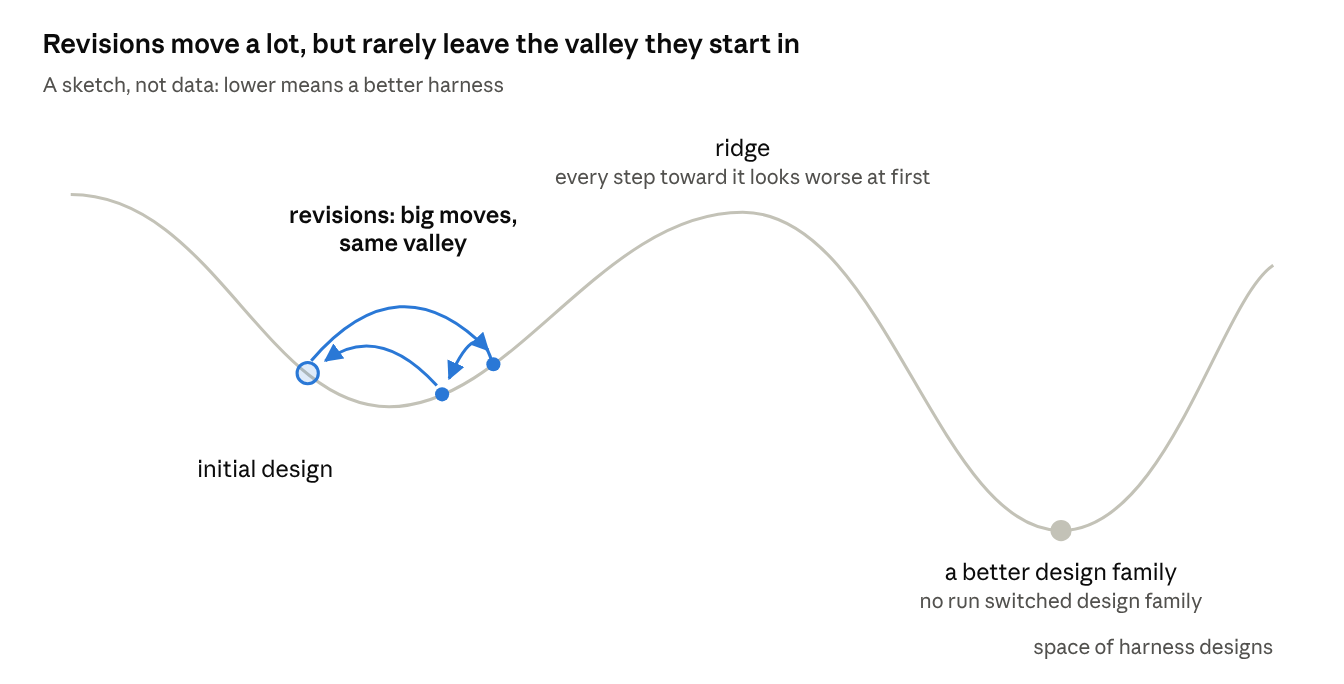
The missing skill here is not editing but judgement: knowing when evidence is strong enough to justify a change, and when to leave a working system alone. This echoes older findings that LLMs struggle to self-correct without reliable external feedback, and newer harness-evolution studies such as SEAGym, HarnessOpt-Bench and Rethinking Harness Evolution, which also find that validation gains overstate test gains.
Hypotheses under sparse reward
Improving a harness is in some sense like running a small research program. You observe a failure, form a hypothesis about its general cause, design a change, test it and keep or discard it. Then you repeat, holding on to a line of inquiry long enough for it to pay off. The traces are rich, but the outcome signal is sparse: a handful of game scores, long after the decision that mattered.
Models are very good at the middle of this loop. Every revision in our study inspected the evidence, targeted an evidence-backed issue and passed its checks. What they seem to lack is the outer layer: forming a hypothesis that goes beyond the game in front of them, and pursuing it consistently instead of reacting to the latest result. Episodes where a model kept re-editing after seeing a new result did, on average, worse than those where it committed and handed off (although that difference is not statistically reliable).
Solving versus asking
Mathematics shows the same asymmetry in a starker form. Models now produce serious claims on problems that have resisted humans for decades, from Navier–Stokes to the Exponential Time Hypothesis. But these questions were posed by humans, formalised by humans, and singled out as important by humans. (The Exponential Time Hypothesis was formulated by Russell Impagliazzo and Ramamohan Paturi around the turn of the millennium.)
Current training rewards solving: there is a question, an answer and a verifier. Asking a good new question has no verifier. It requires a sense of what is interesting, what is tractable, and what would move a field forward. Systems like Absolute Zero propose their own training tasks, but optimise for learnability, not for scientific interest. The open-endedness agenda, as Hughes et al. put it, asks for artefacts that are both novel and learnable to an observer, which is a much harder target. My guess is that harness improvement fails for a related reason: the hard part is not writing the fix, it is choosing which question to ask next.
The same pattern in daily work
I see the same thing in my daily work, and I suspect many of you might feel the same (but let me know). When I give a strong model a multi-day, open-ended task without steering, it is busy the entire time. It writes code, runs experiments, revises, repairs, produces plots and summaries. But at the end, the actual improvement is often small. A few hours of regular human steering, saying “this direction is a dead end” or “this odd result is the interesting one”, changes the outcome of a workstream dramatically.
This is an anecdotal observation, but it lines up with the Tycho experience. There, too, our contribution was selection and creativity: deciding what to pursue in the first place, which of the agents’ observations pointed at something general, which were noise, and which changes were not worth making at all.
Not forever, but not yet
I do not expect this gap to last. Enormous effort is going into recursive self-improvement, continual learning and open-ended task execution. Start-ups such as Recursive Superintelligence, which raised $650 million and counts Tim Rocktäschel and Jeff Clune among its founders, and Sakana AI’s new RSI lab are built around it, and the large labs invest heavily too. Some fixes are simple. In our own data, a post-hoc check suggests that keeping the version that scored best on the development games would have raised the held-out gain from 2.8 to 4.5 points. RRSI reports better transfer when proposals are regularised and acceptance is noise- and cost-aware.
But today, the result is a warning. We are not at the point where we can leave knowledge and reasoning work entirely to LLMs and expect it to improve by itself. The models solve, build and execute brilliantly. They still struggle to judge which change is worth making, to stay with a hypothesis, and to recognise when to stop.
That is where expertise and good intuition still pay off. The more interesting question, though, is how to build this judgement into the agents themselves. Several directions look promising to me:
- Reward decisions, not just outcomes. Training mostly rewards a correct final result. The Tasteful Agent isolates the forks in long trajectories where one direction is clearly better. The best frontier model scores only 59.7%, against a 25% chance baseline, and more reasoning did not help the two models tested, but distilling the judgement of a teacher that has seen the outcome does.
- Curiosity with a model behind it. Amayuelas et al. argue that today’s agents explore by sampling, not by curiosity. Real curiosity needs a predictive model of the environment that is updated online and steers the agent towards what it expects to learn most. That is what crossing a ridge requires.
- Make improvement itself the training task. Self-improvement episodes like ours could become training data, rewarded by held-out gains instead of development gains, with “no change” as a legitimate action. In other words: train the outer loop, not only the inner one.
- Benchmarks that demand it. ARC Prize has announced that ARC-AGI-4 will be a benchmark for autonomous open-ended innovation. If ARC-AGI-3 is any guide, a shared target like that pulls research in its direction quickly.
Until such ideas mature, a few hours of human direction still buy more than days of autonomous effort. At least for now.
References and further reading
Our work
- J. Lehmann, S. Vahdati. Can LLMs Improve Their Own Harness? A Controlled Study on ARC-AGI-3. arXiv, 2026.
- J. Lehmann, A. Aioanei, S. Vahdati. Tycho: Active Abstraction with Programmatic World Models for ARC-AGI-3. arXiv, 2026.
Measuring intelligence and progress
- F. Chollet. On the Measure of Intelligence. 2019.
- ARC Prize. ARC-AGI-3 launch, March 2026.
- ARC Prize. OpenAI’s GPT-6 Astra on ARC-AGI-3, September 2026; official leaderboard and community leaderboard.
- F. Chollet. Post on Astra’s ARC-AGI-3 result and post on harnesses and general intelligence. X, 2026.
- T. Kwa et al. (METR). Measuring AI Ability to Complete Long Software Tasks. 2025.
- H. Wijk et al. RE-Bench. ICML 2025.
Self-improvement: weights and harnesses
- A. Zweiger et al. Self-Adapting Language Models (SEAL). 2025.
- A-Evolve-Training and AI4AI-Bench. 2026.
- Y. Lee et al. Meta-Harness. 2026.
- J. Lin et al. Agentic Harness Engineering. 2026.
- J. Zhang et al. Darwin Gödel Machine. ICLR 2026.
- P. Xia et al. RRSI: Regularized Recursive Self-Improvement of Agent Harnesses. 2026.
- M. Chen et al. Recursive Self-Improvement in AI. Survey, 2026.
When updates don’t transfer
- J. Huang et al. Large Language Models Cannot Self-Correct Reasoning Yet. ICLR 2024.
- C. Zheng et al. SEAGym. 2026.
- V. Ursekar et al. HarnessOpt-Bench. 2026.
- Y. Wang et al. Rethinking the Evaluation of Harness Evolution for Agents. 2026.
Harnesses for ARC-AGI-3
- OpenAI. How enabling two settings tripled our ARC-AGI-3 scores. 2026.
- G. Zeng et al. Schema. 2026.
Open-endedness and asking questions
- K. Stanley, J. Lehman. Why Greatness Cannot Be Planned: The Myth of the Objective. Springer, 2015.
- E. Hughes et al. Open-Endedness is Essential for Artificial Superhuman Intelligence. ICML 2024.
- A. Zhao et al. Absolute Zero: Reinforced Self-play Reasoning with Zero Data. 2025.
- W. Pan et al. The Tasteful Agent: Measuring and Improving Taste in Long-Horizon Tasks. 2026.
- A. Amayuelas et al. Sampling Is Not Curiosity: Why LLM Agents Should Investigate. NeurIPS 2026.
- ARC Prize. ARC-AGI-4 announcement. X, 2026.
- Recursive Superintelligence and Sakana AI’s RSI lab. News coverage, 2026.
Safety
- Y. Bengio. Why are AI agents lying, cheating and coordinating? Blog, September 2026.
Mathematics
- Smithsonian Magazine. A.I. may have solved a longstanding math problem. 2026.
- Papex. Has AI solved a Millennium Prize Problem? (as of Oct 2026).
- Wikipedia. Exponential time hypothesis, including the October 2026 refutation claims by OpenAI and Anthropic.